The real cost of S3: 8 providers compared, egress included
Every "S3 pricing comparison" ranks providers by the storage line: $0.023 here, $0.00695 there. That number is almost meaningless.
On a real invoice, storage is often a minority. Egress, request volume, retrieval fees, replication and minimum-storage durations decide the bill — and they scale differently for every workload. A provider that is 3× cheaper per stored gigabyte can be 5× more expensive the moment you actually serve the data.
So we modelled it. Eight providers, four workloads, one formula, every component included.
What we modelled (and what we did not)
Monthly cost = storage + egress + requests + base fee, for a steady-state month.
- Storage: GB-month, binary gigabytes (1 TB = 1,024 GB), as every provider bills it.
- Egress: internet data transfer out, after each provider's free allowance and fair-use rules.
- Requests: PUT/LIST and GET class pricing, at the volume each scenario implies.
- Not modelled: cross-region replication transfer (treated separately in scenario 4), retrieval fees for cold tiers, Transfer Acceleration, and support plans.
Prices are list prices captured on 30 October 2026 from each vendor's pricing page, in USD. They change constantly — treat the shape of the curves as the durable insight, not the exact dollars.
The five components nobody quotes
- Storage per GB-month. The headline, and the least interesting.
- Egress per GB. Ranges from $0 to $0.12 — a 12× spread on the same gigabyte.
- Requests. Negligible below ~50M/month, decisive above ~500M/month.
- Minimum durations. Wasabi bills 90 days whether you keep the object 90 days or 90 minutes. GCS Nearline is 30 days, Coldline 90, Archive 365.
- Minimum billable size. S3 Standard-IA bills 128 KB minimum per object — a million 4 KB objects cost you 32× their real size.
Items 4 and 5 are where "cheap" providers quietly become expensive.
The list prices
| Provider | Storage $/GB-mo | Egress $/GB | Free egress | Requests (PUT / GET per 1M) |
|---|---|---|---|---|
| AWS S3 (us-east-1) | 0.023 | 0.09 | 100 GB | $5.00 / $0.40 |
| Google Cloud Storage | 0.020 | 0.12 | 100 GB | $5.00 / $0.40 |
| Cloudflare R2 | 0.015 | 0 | unlimited | $4.50 / $0.36 |
| Backblaze B2 | 0.00695 | 0.01 | up to 3× stored | free |
| Wasabi | 0.00799 | 0 (fair use) | policy-bound | free |
| DigitalOcean Spaces | 0.02 (after 250 GiB) | 0.01 | 1 TiB | free |
| OVHcloud (Standard 3-AZ) | 0.0157 | 0 | unlimited | free |
| MinIO (self-hosted) | ~fixed infra | 0 | n/a | free |
Two entries deserve immediate suspicion. R2's $0.015 is more than double Backblaze's $0.00695. And Wasabi is cheaper per GB than R2 while also having no egress fees — on paper, R2 loses to Wasabi on every axis. Keep that in mind for the rest of the article.
Scenario 1 — Backup & archive
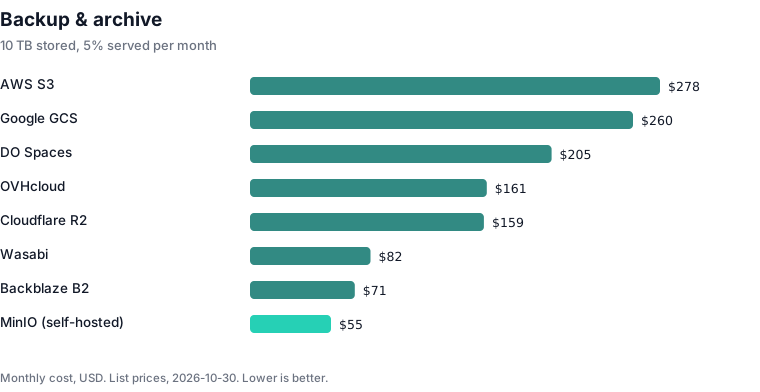
10 TB stored, 5% served per month (512 GB), 1M PUT, 2M GET.
| Provider | Monthly |
|---|---|
| MinIO (self-hosted) | $55 |
| Backblaze B2 | $71 |
| Wasabi | $82 |
| Cloudflare R2 | $159 |
| OVHcloud | $161 |
| DigitalOcean Spaces | $205 |
| Google Cloud Storage | $260 |
| AWS S3 | $278 |
For cold-ish data, storage price dominates and Backblaze wins the managed providers at $6.95/TB. AWS costs 3.9× more than B2 for the same 10 TB.
Note that R2 lands mid-table. Its free egress buys nothing when you barely egress.
Scenario 2 — Application data
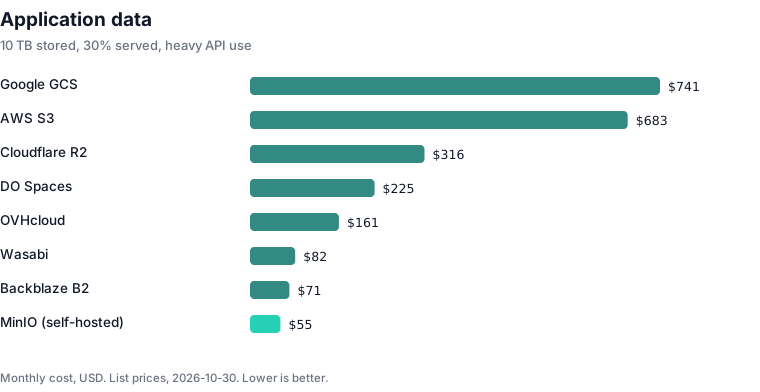
10 TB stored, 30% served (3 TB), 20M PUT, 200M GET — a typical SaaS tenant dataset.
| Provider | Monthly |
|---|---|
| MinIO (self-hosted) | $55 |
| Backblaze B2 | $71 |
| Wasabi | $82 |
| OVHcloud | $161 |
| DigitalOcean Spaces | $225 |
| Cloudflare R2 | $316 |
| AWS S3 | $683 |
| Google Cloud Storage | $741 |
R2 climbs because 200M GET requests cost $72 and its storage premium bites. AWS and GCS are now 8–10× B2. At this egress ratio, B2's "3× free" rule is still not binding (3 TB < 3 × 10 TB).
Scenario 3 — Media distribution: the egress cliff
5 TB stored, but 20 TB served per month — a 400% egress ratio, normal for video, images or public datasets.
| Provider | Monthly |
|---|---|
| Wasabi | $41* |
| MinIO (self-hosted) | $55 |
| OVHcloud | $80 |
| Backblaze B2 | $87 |
| Cloudflare R2 | $194 |
| DigitalOcean Spaces | $297 |
| AWS S3 | $2,082 |
| Google Cloud Storage | $2,678 |
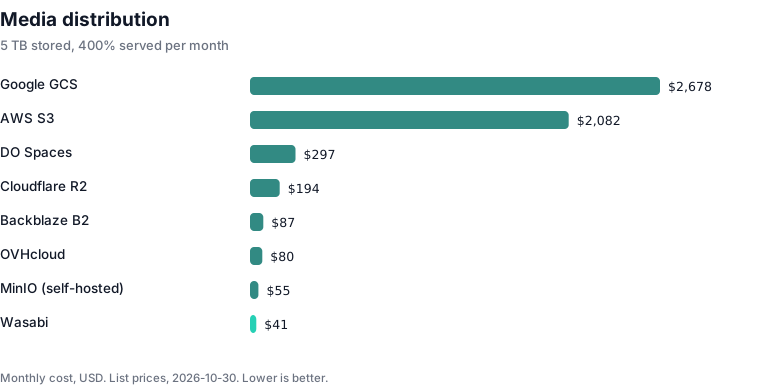
* And this is where the asterisk matters. Wasabi's "no egress fees" is a fair-use policy: free egress is expected to stay around or below your stored volume. Serving 4× your stored data every month is outside that policy — Wasabi can throttle or bill the excess. The $41 is the price if they let you, which for a real media workload they probably won't.
The honest winner for high-egress workloads is Cloudflare R2 or OVHcloud, both with genuinely unlimited free egress. R2 costs 10× less than AWS here; OVH costs 26× less.
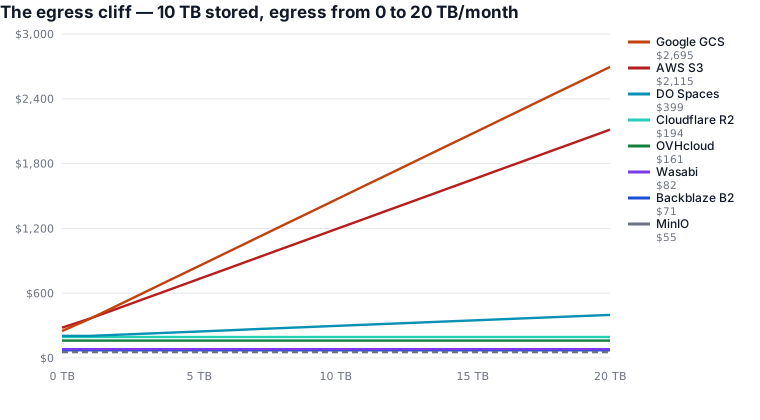
This is the chart to keep. At 20 TB egress per month, AWS costs $2,082 and GCS $2,678, against $194 for R2 and $161 for OVHcloud. Storage is identical in all four cases.
Scenario 4 — Cross-region DR
10 TB primary + 10 TB replica, 5% served.
| Provider | Monthly |
|---|---|
| MinIO (self-hosted) | $55 |
| Backblaze B2 | $142 |
| Wasabi | $164 |
| Cloudflare R2 | $314 |
| OVHcloud | $322 |
| DigitalOcean Spaces | $410 |
| Google Cloud Storage | $527 |
| AWS S3 | $561 |
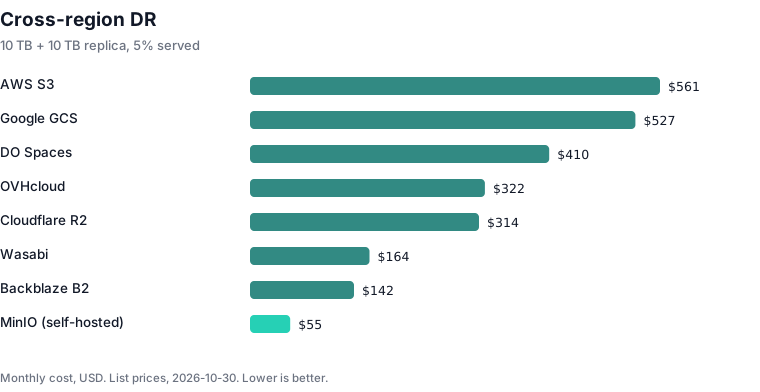
Replication doubles storage and adds inter-region transfer. On AWS, replicating 10 TB across regions costs $0.02/GB in transfer alone — $205 for a one-off, plus double storage forever. B2 and Wasabi stay cheapest because their storage rate is simply lower.
The three traps that break the model
1. Fair-use egress. "Free egress" is not always free. Wasabi ties it to your stored volume; Backblaze caps it at 3× stored; DigitalOcean gives 1 TiB then bills. Only R2 and OVHcloud are unconditional.
2. Minimum storage duration. Wasabi's 90-day minimum means deleting a 10 TB dataset after a week still bills three months — $240 instead of $18. GCS Nearline (30 days) and Archive (365 days) have the same trap. For ephemeral data (CI artifacts, temporary exports), a "cheap" tier can cost more than S3 Standard.
3. Retrieval and request fees at scale. GCS and S3 charge per GB retrieved from cold tiers. At 500M GETs/month, AWS's $0.0004/1,000 becomes $200 — more than the storage of most small buckets.
What the numbers actually say
- Backblaze B2 is the cheapest managed provider for low-to-moderate egress. $6.95/TB and a 3× egress allowance cover most application workloads.
- Wasabi is the cheapest per GB with free egress, but the 90-day minimum and fair-use policy make it a fit for stable, long-lived data only.
- Cloudflare R2 is not the cheapest — it is the safest bet when egress is unpredictable. No minimum duration, no fair-use clause, no egress fee, and it beats AWS on storage by 35%.
- OVHcloud is the dark horse: $0.0157/GB, zero egress, zero API fees, EU sovereign. At high egress it is the cheapest thing on the list.
- AWS and GCS win on ecosystem, tiering depth, regions and compliance — never on this bill.
- MinIO wins below ~30 TB if you already run hardware and value the operational control. Above that, the ops burden grows faster than the savings.
The rule of thumb: compute your egress-to-storage ratio first. Below 30%, buy the cheapest storage. Above 100%, buy the cheapest egress. Everything else is marketing.
Where this model meets your actual bill
Everything above assumes a workload profile. Your real numbers live in your bucket — and the request side is the one nobody looks at, even though it is easy to measure.
S3 Explorer is the desktop client we build. It connects to 25 S3-compatible providers with a read-only key and keeps a local request-metrics dashboard: requests per category, error rate, an hourly distribution, and a cost estimate with a monthly projection, priced from the provider's own request rates.
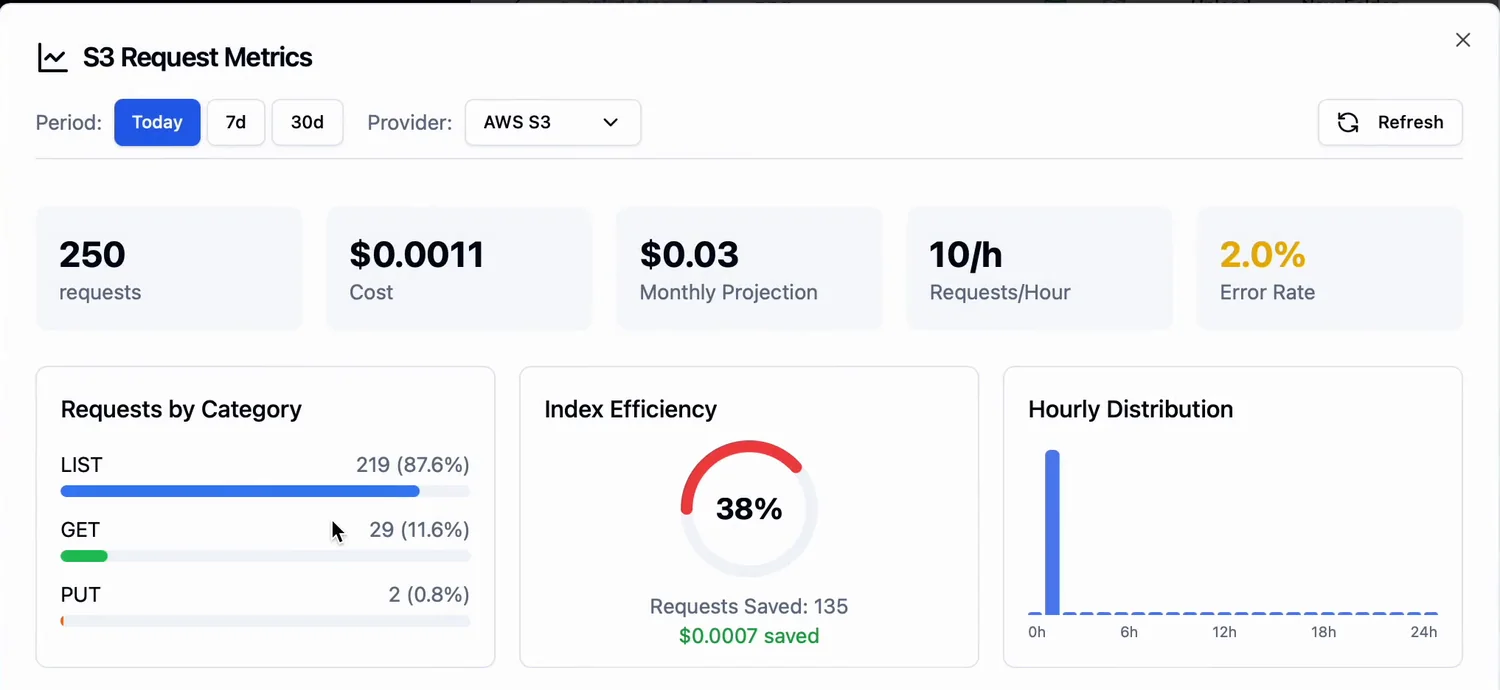
That is a real session against a MinIO endpoint: 250 requests, of which 87.6% were LIST — the exact request type this article prices at $5 per million on AWS. The local index answered 135 of those listings without touching the bucket, and the dashboard turns that into money ($0.0007 on 250 requests — multiply by your real volume before dismissing it).
Requests are one half of the bill. For the egress half, read your provider's usage report, then come back to the scenario that matches your ratio.
Run the numbers on your own buckets. Connect a read-only key and the dashboard shows what your workload actually costs per month — a Rust + Tauri app for Windows, macOS and Linux, free to start.
Sources
List prices captured 30 October 2026: AWS S3, Google Cloud Storage, Cloudflare R2, Backblaze B2, Wasabi, DigitalOcean Spaces, OVHcloud Object Storage.
The model, its assumptions and the raw output are reproducible — the numbers above come from a script, not a spreadsheet.