Presigned URLs leak into logs, referrers and chat
A presigned URL is a working credential stored as text. Where the copy ends up, what it still grants after redaction, and the 15-minute fix.
A support ticket reads: "the invoice link does not work". The link was pasted into the ticket by an engineer, copied into a CRM note by a salesperson, and fetched by the mail gateway that scanned the ticket. Three copies of a valid credential, in three systems that keep text for years, and one expiry date that nobody in the conversation controls.
The short version
- A presigned URL is not a link to a file. It is a signature — a working credential written into the address of the object.
- Anyone holding the string can fetch the object until the moment written inside it. No password, no identity check, no record of who used it.
- Measured today with botocore 1.43: a 900-second
GETlink is 334 characters, 1 009 when signed with a session token. The signature is 64 of those characters, and it is the only part that grants access. - Every system that stores URIs keeps a copy — access log, CDN, WAF, TLS proxy, the chat client that builds a preview, the ticket where it was pasted — and most keep it for a year, redacting nothing.
- Kill one leaked URL by deleting its access key and every other live link signed with that key dies in the same second.
What actually happens
Presigning is arithmetic performed on the client: a canonical request is hashed with a key derived from the secret access key, the date, the region and the service, and the result is appended to the URL. No API call is made — which is why it works offline, and why nobody can stop you from generating a bad one.
That also means the credential is readable text. Building a URL with a throwaway key pair and printing its parameters gives the inventory:
python3 -m venv presign-venv && ./presign-venv/bin/pip -q install boto3
# presign-one.py — no AWS account, no network: fake keys produce a valid structure
import boto3, urllib.parse
from botocore.config import Config

s3 = boto3.client("s3",
    aws_access_key_id="AKIAIOSFODNN7EXAMPLE",
    aws_secret_access_key="wJalrXUtnFEMI/K7MDENG/bPxRfiCYEXAMPLEKEY",
    region_name="eu-west-3",
    config=Config(signature_version="s3v4", s3={"addressing_style": "virtual"}))

url = s3.generate_presigned_url("get_object",
    Params={"Bucket": "docs-prod", "Key": "contracts/acme-2026.pdf"}, ExpiresIn=900)

print(len(url))                                    # 334
for k, v in urllib.parse.parse_qsl(urllib.parse.urlparse(url).query):
    print(f"{k:24} {len(v):4}  {urllib.parse.unquote(v)[:60]}")
The output, trimmed to the columns that matter:
X-Amz-Algorithm          value=16  AWS4-HMAC-SHA256
X-Amz-Credential         value=55  <access key id>/20261104/eu-west-3/s3/aws4_request
X-Amz-Date               value=16  20261104T110619Z
X-Amz-Expires            value=3   900
X-Amz-SignedHeaders      value=4   host
X-Amz-Signature          value=64  4b4ec51ce28bf30ce5e92301ee45a6...
Three things follow from that listing, and none of them is visible when the URL is a blue link in a chat window.
The URL names the principal. X-Amz-Credential carries the access key ID in clear, with the signing date, region and service. A leaked URL tells the reader which key to hunt for. Signed with temporary credentials, the same query string carries X-Amz-Security-Token — 653 characters in the same test, taking the URL to 1 009. That token is not a credential on its own, since SigV4 still needs the matching secret, but it pins the session: a log reader knows which role signed the link and when it ends.
Only one header is signed. X-Amz-SignedHeaders is host. Everything else — Range, User-Agent, conditional headers — can be added or changed by whoever holds the URL. A 5 GB object behind a 15-minute link is not a 15-minute download: it is as many ranged requests as the holder cares to send inside the window. AWS documents the mirror image in its FAQ — once Range is signed, S3 demands If-Range be signed too, and answers AccessDenied with HeadersNotSigned: if-range when it is not.
There is no handle to revoke. AWS states the position plainly: "In essence, presigned URLs are bearer tokens that grant access to those who possess them." The server never asks who is calling. There is no list of issued URLs, no per-URL delete, no IP binding, no single-use mode — only the expiry inside the link and the validity of the credential behind it.
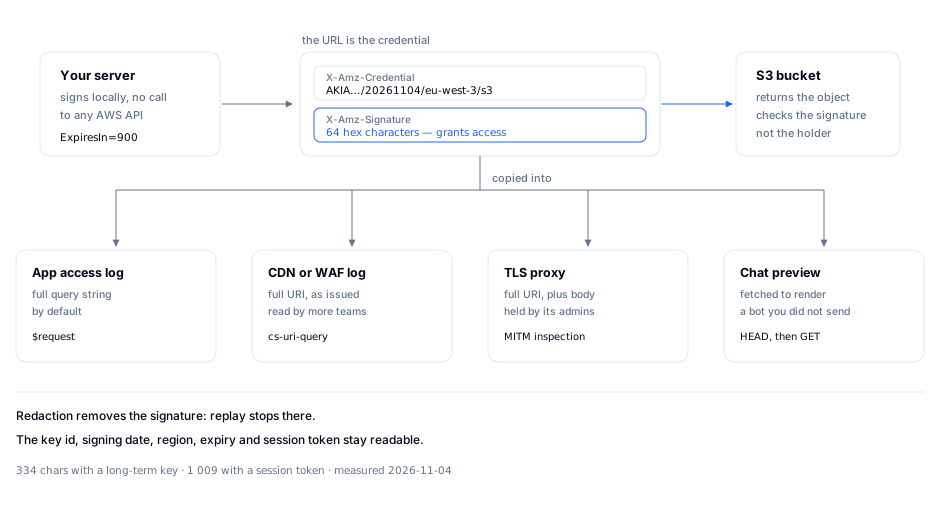
Where it bites
The interesting part is not that a URL can leak. It is that the industry-standard mitigation removes the wrong half.
AWS's prescriptive guidance on presigned URLs recommends redacting the X-Amz-Signature parameter from any URI log, and says S3 does it: "Amazon S3 server access logs include the request URI but redact the X-Amz-Signature … The same is true when CloudTrail data events are logged for Amazon S3." Applying the published regex X-Amz-Signature=[a-f0-9]{64} to the URL above leaves this:
https://docs-prod.s3.eu-west-3.amazonaws.com/contracts/acme-2026.pdf
  ?X-Amz-Algorithm=AWS4-HMAC-SHA256
  &X-Amz-Credential=<key id>%2F20261104%2Feu-west-3%2Fs3%2Faws4_request
  &X-Amz-Date=20261104T110534Z
  &X-Amz-Expires=900
  &X-Amz-SignedHeaders=host
  &X-Amz-Signature=XXXXXXXX…XXXXXXXX
Redaction kills replay, which is the important half. It does not hide the key ID, the signing date, the region, the expiry, or the session token. A log therefore remains an identity disclosure after redaction, and its reader learns which credential to attack — a smaller problem than a live link, and a much larger one than zero.
| Where the URL is written | What survives | What it costs you |
|---|---|---|
Application access log (nginx, API gateway) | The whole query string by default | A year of replayable links on disk |
| S3 server access log, CloudTrail data events | URI with X-Amz-Signature redacted | Identity and expiry disclosure only |
| CDN, WAF, load-balancer logs | Usually the full URI | The same, in a system with wider read access |
| TLS-inspecting proxy, mail gateway | Full URI, plus the body | The proxy team holds your links |
| Chat client, ticket, CRM, PDF | The literal string, forever | Outlives every retention policy on the bucket |
Two failure modes hide in that table.
The link preview that spends the link. Paste a presigned URL into a chat client or a ticketing tool and that service fetches it to render a preview or scan for malware. The request is real and appears in your access logs, so the first "click" in your analytics is a bot from a datacentre IP you do not recognise.
The seven-day window nobody chose. Asked for "a link that works for a month", the SDK returns the maximum instead of an error. That link then sits in a log for a week, which is where redaction is the only thing between a log reader and the object. The mechanics of that ceiling, and the three other clocks that shorten a link, are in Presigned URLs expire at seven days. Then what?.
Upload URLs fail differently, because the signed policy is the whole document. A presigned PUT that does not pin content type and size hands the holder permission to write any file of any size under that key — the mechanism and the exact condition syntax are in Presigned POST: cap size and type before the upload starts.
Doing it right
1. Shorten the window until it hurts. Fifteen minutes covers a click-through. Anything longer is a decision, not a default. Measure what you actually issue rather than what you asked for:
grep -o 'X-Amz-Expires=[0-9]*' /tmp/presigned.url
2. Put a floor under the TTL at the bucket. The s3:signatureAge condition key caps how old a signature may be, regardless of what the URL claims. It is expressed in milliseconds — 900 000 is fifteen minutes, not 900 seconds — and AWS notes that values below 60 seconds produce random failures on clock skew:
{
  "Version": "2012-10-17",
  "Statement": [{
    "Sid": "DenyPresignedOver15Minutes",
    "Effect": "Deny",
    "Principal": "*",
    "Action": "s3:*",
    "Resource": "arn:aws:s3:::docs-prod/*",
    "Condition": { "NumericGreaterThan": { "s3:signatureAge": "900000" } }
  }]
}
A Deny beats any Allow, whatever the order of the statements, which is why a bucket policy is the right place for this and not the application.
3. Deny query-string authentication where it is never needed. s3:authType distinguishes header-signed requests (REST-HEADER) from presigned ones (REST-QUERY-STRING). Buckets that are only read by services can refuse every presigned request outright:
{
  "Sid": "DenyNonHeaderAuth",
  "Effect": "Deny",
  "Principal": "*",
  "Action": "s3:*",
  "Resource": "arn:aws:s3:::docs-prod/*",
  "Condition": { "StringNotEquals": { "s3:authType": "REST-HEADER" } }
}
AWS warns about the side effect: the S3 console downloads objects with presigned URLs, so on a bucket carrying this statement the console's Download button stops working for everyone without an exception.
4. Redact in your own logs, then check that you did. AWS publishes the pattern; use it in the log format rather than in a downstream parser you will forget to update.
# nginx: map the query away before it reaches the log line
map $args $safe_query {
    default            "";
    "~^(?<keep>.*)X-Amz-Signature=[a-f0-9]{64}(?<rest>.*)$"  "$keep""X-Amz-Signature=REDACTED""$rest";
}
log_format redacted '$remote_addr "$request_method $uri?$safe_query" $status';

# and prove it on the files you already have
grep -rlE 'X-Amz-Signature=[a-f0-9]{64}' /var/log/ /var/awslogs/ 2>/dev/null | head
That grep is the audit: every file it prints holds live credentials for the length of their TTL.
5. Make single-use links real, in your own state. S3 has no single-use mode. A nonce table is enough: mint the URL behind your own authentication, store a hash of the nonce with the object key, delete the row on the first successful redirect to S3. A second request with the same nonce gets a 410 from your server, not from S3.
6. Do not try to bind a URL to an IP. You cannot put an IP into the signature. What you can do is restrict the signing principal with aws:SourceIp — evaluated at request time against the address the request arrives from, not the address of the service that signed it.
How S3 Explorer fits
When a link fails, the question is which credential signed it, against which endpoint, and whether that key still sees the bucket. S3 Explorer's connection form takes a display name, endpoint, region, path-style toggle and credentials, and Test connection reports how many buckets those credentials can actually see before you save the profile — the difference between an expired link and a key that lost its permission. The per-request metrics dashboard counts the session's API calls by category, turning a wall of 403s into a number, and switching between connection profiles puts production and staging side by side. S3 Explorer runs on Windows, macOS and Linux.
Checklist
- Every
generate_presigned_urlcall site passes an explicitExpiresIn, and no value exceeds 900. -
grep -rE 'X-Amz-Signature=[a-f0-9]{64}'over your log directories returns nothing. - A bucket policy
Denyons3:signatureAge(milliseconds) exists on every bucket that issues links. - Buckets read only by services carry the
s3:authTypedeny, with console users exempted if they need it. - Single-use links are enforced by a nonce table on your side, not by hoping.
- The signing credential is dedicated, temporary, and scoped to the prefix that needs it.
- Support and sales know that a pasted link is a credential: the runbook says rotate, not "wait for it to expire".
- You have replayed a redacted log line and seen which fields are still readable.
Sources
- AWS Prescriptive Guidance — Logging interactions and mitigations: the bearer-token framing, the S3 access-log and CloudTrail redaction of
X-Amz-Signature, and theX-Amz-Signature=[a-f0-9]{64}pattern. - AWS Prescriptive Guidance — Additional guardrails:
s3:signatureAgein milliseconds, the 60-second practical floor,s3:authTypeREST-QUERY-STRINGversusREST-HEADER, and the console caveat. - AWS Prescriptive Guidance — Foundational best practices:
aws:SourceIpevaluated at request time from the requesting system. - Amazon S3 — Download and upload objects with presigned URLs: "presigned URLs are bearer tokens", the console's 1-minute-to-12-hour range, the
HeadersNotSigned: if-rangeerror. - Amazon S3 — Server access log format: the
Request-URIfield example carrying a query string, andAuthentication Type=QueryStringfor presigned requests.
Measurements taken on 4 November 2026 with botocore 1.43.123, eu-west-3, virtual-hosted addressing, bucket docs-prod, key contracts/acme-2026.pdf, ExpiresIn=900; the key pair is the AWS documentation placeholder, never a real credential.
Keep reading
- Presigned URLs expire at seven days. Then what?Seven days is not a setting: it is how long the SigV4 signing key lives. What happens at that wall, and the three patterns that outlive it.
- Presigned POST: cap size and type before the upload startsA presigned PUT signs a URL, not a byte count. A POST policy adds a size range and a content-type condition that S3 enforces while the body arrives.