S3 in 2027: the egress bill changes on 12 January
The EU Data Act removes switching fees in January 2027 — but not everyday egress. The five things you need to know about your buckets before that date.
Search for "S3 2027" and five of the first eight results are a car. The rest are trend pieces about GPUs and vector databases. Nobody is writing about the thing that actually has a date attached to it: on 12 January 2027, the EU Data Act makes it illegal to charge an EU customer for the egress involved in leaving.
That is not a forecast. It is a paragraph in a regulation, and it lands harder on object storage than on any other part of a cloud bill, because object storage is the part nobody has a complete inventory of.
The short version
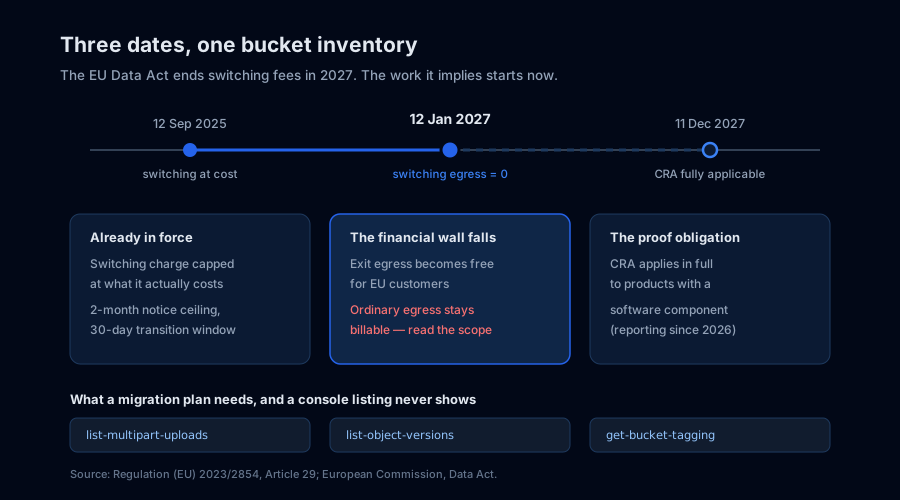
- 12 January 2027 — Article 29 of the EU Data Act (Regulation 2023/2854) takes full effect: no switching fees, egress included, when an EU customer moves to another provider or back on-premises.
- Everyday egress is still billed. The ban covers the export you do to leave. Ordinary traffic, cross-region reads and CDN pulls stay chargeable.
- The financial lock-in weakens. The technical lock-in does not: someone still has to enumerate what is in the buckets, who can read it, and what it costs.
- Three of the five items below are things you cannot learn from a bucket listing — and that is the actual 2027 problem.
What actually happens
The date, precisely
The Data Act entered into force in January 2024 and became applicable on 12 September 2025. Chapter VI (Articles 23 to 31) targets cloud lock-in. Since that September date, providers can only charge at cost for switching, customer notice periods are capped at two months, and a 30-day transition window is mandatory. From 12 January 2027, the switching charge itself is gone.
Read the scope carefully, because most vendor summaries do not: the ban applies to data egress and administrative penalties incurred when switching or running in parallel across providers. It does not abolish fixed-term commitments, and it does not touch the egress you generate in normal operation. AWS had already dropped exit fees in March 2024, before the rules required it; the regulation turns a courtesy into an obligation for everyone.
The practical consequence: leaving becomes a technical project with no invoice attached, instead of a technical project with a penalty attached. That is a much better problem, and a much more honest one.
The scale you are working at
In December 2025 AWS reported S3 passing 500 trillion objects, and raised the maximum single object to 50 TB. Both numbers matter for the same reason: at that size, the debris is not debris. An abandoned multipart upload of a 50 TB object keeps its parts — billed as storage, invisible in a listing — until someone aborts it.
This is not an edge case. Large uploads are the ones that get interrupted: a laptop closes, a CI job is cancelled, a network drops at hour six. The parts stay.
The new client is not a person
S3 stopped being a place where a human browses files. With S3 Vectors generally available in December 2025 — two billion vectors per index — a bucket is now a retrieval layer behind a model, written and read by code that has no idea what a folder is.
That changes what a credential means. A presigned URL handed to an agent is a capability with a timer, and the timer is the security control. Which is why the rclone advisory of October 2026 is worth reading twice: a presigned PUT URL could read any bucket in the account, fixed in 1.75.2. The client was doing what clients do — trusting the URL it was given.
The exposure is not theoretical
The Cloud Exposure Index counted 484,142 public buckets and 18.05 billion files in October 2026, 71.9% of them on S3. Tenable's analysis found sensitive data in 16.7% of AWS buckets it sampled. Very little of that was a deliberate decision to publish; most of it was a policy nobody re-read after a migration.
Where it bites
Three failures, in the order they will find you.
1. You cannot renegotiate what you cannot enumerate. A migration plan needs per-bucket size, object count, version count, incomplete uploads, and where the egress actually goes. The console shows objects. It does not show the uploads that never became objects, the non-current versions still billed, or which bucket is responsible for the egress line.
2. You cannot prove who signed what. After an incident, "an agent with the wrong key" is not an answer. Which key, which session, which endpoint, which timestamp — the controls that produce those answers (ABAC on object tags, short presigned lifetimes, session-scoped credentials) are all configuration you have to write down.
3. "S3-compatible" is a claim, not a specification. The moment leaving becomes free, the second provider stops being hypothetical. That is when checksum headers (CRC64NVME is now the SDK default) start failing against older gateways, path-style addressing reappears, and a provider's "compatible" turns out to mean "compatible with what our SDK did in 2023".
Doing it right
A checklist you can run this week, not in December 2027.
Inventory, per bucket, and keep the output.
aws s3api list-multipart-uploads --bucket my-bucket
aws s3api list-object-versions --bucket my-bucket --max-items 100
aws s3api get-bucket-tagging --bucket my-bucket
The first one is the one people skip. Anything listed there is storage you are paying for and cannot see in a normal listing.
Stop the bleeding at the source. A lifecycle rule with
AbortIncompleteMultipartUpload set to a few days turns a permanent leak into a
delay. It does not clean up what already exists — that is a one-off abort.
Attribute the egress before someone asks. Cost allocation tags on buckets, and a look at which prefixes leave the cloud. A bill you can explain is a bill you can negotiate.
Make access expressible. Tag-based policies (s3:ExistingObjectTag) let you
say "tenant A may read tenant A's objects" without enumerating prefixes. Note the
limits we wrote about before: tags are not visible to ListObjectsV2, and
s3:ExistingObjectTag is unsupported on PutObject.
Test the second provider now, while nothing forces you to. One bucket, one key, one file with a checksum. You will learn more in twenty minutes than in a quarter of architecture review.
How S3 Explorer fits
The tooling gap in this article is narrow and real: a bucket viewer that shows objects but not the debris, the versions, the tags or the request pattern leaves you exactly where the regulation found you.
S3 Explorer shows, per connection: a connection test that reports the bucket count before you browse, bucket cards that flag incomplete uploads older than a configurable threshold with the key, age and size of each, object metadata and version tabs, and a per-request metrics panel so the traffic you are paying for is visible while you work. Connections are per profile, which is what makes a second provider a two-minute test rather than a project.
It is a desktop client for Windows, macOS and Linux, and it is built by the publisher of this blog. That is the disclosure; the checklist above stands on its own without it.
The Data Act dates come from the European Commission's Data Act page and the regulation text; the 12 January 2027 deadline and its scope (switching only, not ongoing egress) follow Article 29 and the Commission's guidance as summarised by MoveInfra, October 2026. Object counts, public bucket figures and the rclone advisory are dated inline. Figures for egress pricing come from a 2026 comparison across 18 providers and will move.
Keep reading
- The real cost of S3: 8 providers compared, egress includedStorage is 20% of your bill. We modelled 8 S3 providers across 4 workloads — backup, app, media, DR — with storage, egress, requests and replication.
- Multipart upload: the 5 MiB floor and the 10,000-part ceilingA single PUT stops at 5 GiB. Splitting a 60 GB file moves the failure rather than removing it: the 5 MiB part floor is checked last, after every byte is sent.